Hosanna to the Son of David. Blessed is he who comes in the name of the Lord. Hosanna in the highest.
This post includes audio. Listen on Substack
My first Palm Sunday at St. John’s was a bit disorienting for me. I wasn’t ready for the quick shift from the celebration of Palm Sunday into the solemnity of the Passion. But there is a tension here that I think we really need to lean into.
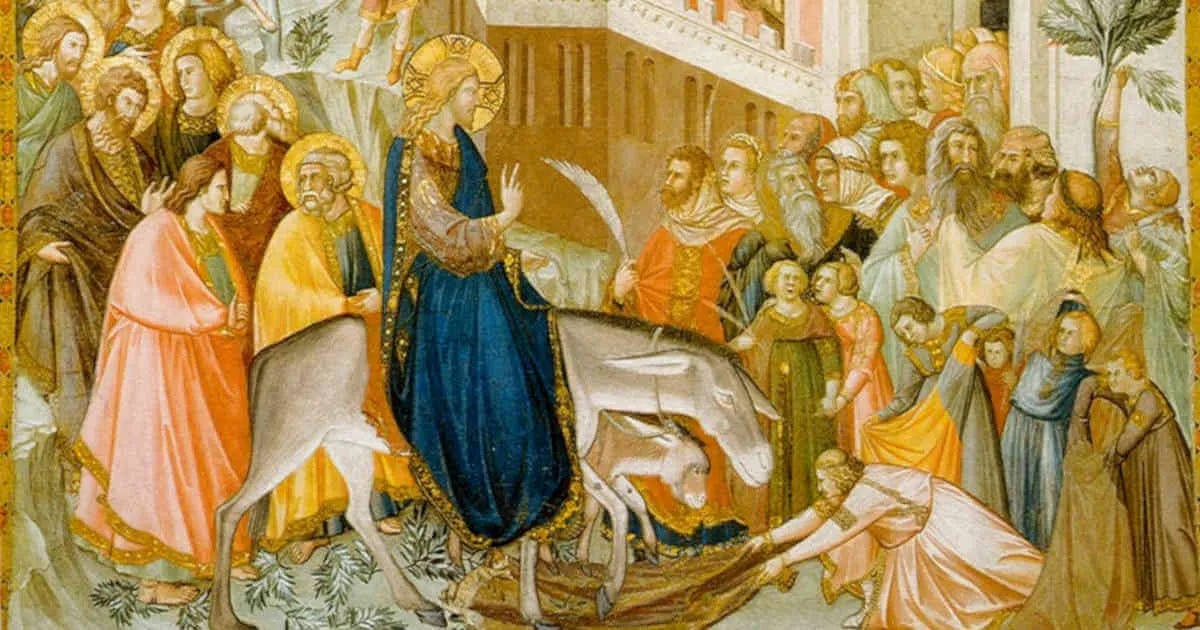
We all began this morning on the labyrinth. With palms in hand, we sang Hosanna as we made our way into the church. It felt exuberant, especially for our kids. I could feel something of what it must have been like for a king to come home. And then, just a little while later, here we are, having heard the Passion Gospel. We went from joyous celebration to the betrayal, the mockery, the beatings, and ultimately the crucifixion of our Lord.
The Church Will Not Let Us Choose
We came in waving branches. We are leaving with the body of Christ in our minds.
This is not done by accident. The Church holds Palm Sunday and Passion Sunday together in one liturgy because she knows something about us as followers of Christ. We carry both of these responses in our hearts at all times. The same people who shouted Hosanna are the same ones who would be crying, Crucify him, just days later.
I remember studying the Triumphal Entry in my undergraduate work and spending some time with the word Hosanna. For us today, it is a word of excitement and celebration, a kind of victory cry. We pray it at every Eucharist. But that is not how it was used here. The people of Jerusalem were not simply celebrating Christ’s arrival. They were crying out to be saved. Hosanna is, at its root, a cry for salvation.
And yet there was still, in that moment, an expectation that the Messiah would overthrow the Romans and restore a strong earthly king over Israel. To say the least, they were wrong about what salvation would look like. And so by Friday, they had decided that this Jesus was not the savior they wanted.
You may have noticed that some of our own faithful shouted Crucify him during the Passion today. It is a reminder that at different points in our lives, we are each of these reactions to Christ. The liturgy has made us confront both of them this morning.
Before we read the Passion, we read one of the most beautiful passages in the entire New Testament. In St. Paul’s letter to the church at Philippi, he frames for us everything we are about to witness, and sets the stage for Holy Week. Paul here records what is very likely one of the earliest Christian hymns we possess. It gives voice to what God does in the person of Christ, and it does so by intentionally moving downward.
Though he was in the form of God, he did not regard equality with God as something to be grasped, but he emptied himself, taking the form of a slave, being born in human likeness. And being found in human form, he humbled himself and became obedient to the point of death, even death on a cross.
From the form of God, to a slave, to death, to one of the most excruciating and humiliating deaths of the ancient world. Each phrase descends just a little lower than the one before. This is how Christ’s love brought him into the world.
And then the hymn turns. Therefore God highly exalted him. But notice what Paul does not say. He does not say that the exaltation erased the cross. The risen Lord is also the crucified Lord. The exaltation vindicates the cross, but it does not undo it.
So when we arrive at St. Matthew’s Passion, we are not simply watching a tragedy unfold. We are watching, enacted before us, what St. Paul wrote.
Why Did It Have to Happen This Way?
But we have a right to ask the harder question, the one most of us have probably asked at some point. Why did it have to happen this way? Why could the Son of Man not have redeemed the world through something less brutal, less public, less shameful?
Fortunately, we have been immersed in St. Athanasius’s On the Incarnation through the Dead Theologians Society, so I get to hit the easy button here.
Athanasius’s first answer is this: the Word assumed our condition because death belongs to the body, and only by taking a body could death be confronted from within death itself. Christ did not defeat death by declaring it overcome from outside creation, or from outside human nature. He entered what death could reach, what death had dominion over. He made our dying his dying, and then destroyed it from the inside. Athanasius writes that the Word bore death in order to abolish death. Seen this way, Christ’s death is not a transaction. It is medicine. You cannot cure a disease by avoiding it. You have to go into it.
Athanasius goes further and asks why the cross specifically. Why could Christ not have died quietly, peacefully, at home? Why did it have to be the most public, the most violent, and the most shameful death that existed?
His answer is twofold. First, a private death would have been forgotten and doubted. The cross was public. It was witnessed. It was documented. Christ’s death is undeniable, and the shame was precisely the point of the witness. Second, drawing on the book of Deuteronomy, Athanasius reminds us that anyone hung on a tree is cursed. The cross was not incidentally shameful. It was theologically cursed ground. And Christ entered that cursed ground so that the curse could be extinguished in him, leaving no room for that curse to stand against us.
Here is the cleaned-up sermon transcript, preserving your voice throughout:
Hosanna to the Son of David. Blessed is he who comes in the name of the Lord. Hosanna in the highest.
Good morning.
My first Palm Sunday at St. John’s was a bit disorienting for me. I wasn’t ready for the quick shift from the celebration of Palm Sunday into the solemnity of the Passion. But there is a tension here that I think we really need to lean into.
We all began this morning on the labyrinth. With palms in hand, we sang Hosanna as we made our way into the church. It felt exuberant, especially for our kids. I could feel something of what it must have been like for a king to come home. And then, just a little while later, here we are, having heard the Passion Gospel. We went from joyous celebration to the betrayal, the mockery, the beatings, and ultimately the crucifixion of our Lord.
We came in waving branches. We are leaving with the body of Christ in our minds.
This is not done by accident. The Church holds Palm Sunday and Passion Sunday together in one liturgy because she knows something about us as followers of Christ. We carry both of these responses in our hearts at all times. The same people who shouted Hosanna are the same ones who would be crying, Crucify him, just days later.
I remember studying the Triumphal Entry in my undergraduate work and spending some time with the word Hosanna. For us today, it is a word of excitement and celebration, a kind of victory cry. We pray it at every Eucharist. But that is not how it was used here. The people of Jerusalem were not simply celebrating Christ’s arrival. They were crying out to be saved. Hosanna is, at its root, a cry for salvation.
And yet there was still, in that moment, an expectation that the Messiah would overthrow the Romans and restore a strong earthly king over Israel. To say the least, they were wrong about what salvation would look like. And so by Friday, they had decided that this Jesus was not the savior they wanted.
You may have noticed that some of our own faithful shouted Crucify him during the Passion today. It is a reminder that at different points in our lives, we are each of these reactions to Christ. The liturgy has made us confront both of them this morning.
Before we read the Passion, we read one of the most beautiful passages in the entire New Testament. In St. Paul’s letter to the church at Philippi, he frames for us everything we are about to witness, and sets the stage for Holy Week. Paul here records what is very likely one of the earliest Christian hymns we possess. It gives voice to what God does in the person of Christ, and it does so by intentionally moving downward.
Though he was in the form of God, he did not regard equality with God as something to be grasped, but he emptied himself, taking the form of a slave, being born in human likeness. And being found in human form, he humbled himself and became obedient to the point of death, even death on a cross.
From the form of God, to a slave, to death, to one of the most excruciating and humiliating deaths of the ancient world. Each phrase descends just a little lower than the one before. This is how Christ’s love brought him into the world.
And then the hymn turns. Therefore God highly exalted him. But notice what Paul does not say. He does not say that the exaltation erased the cross. The risen Lord is also the crucified Lord. The exaltation vindicates the cross, but it does not undo it.
So when we arrive at St. Matthew’s Passion, we are not simply watching a tragedy unfold. We are watching, enacted before us, what St. Paul wrote.
But we have a right to ask the harder question, the one most of us have probably asked at some point. Why did it have to happen this way? Why could the Son of Man not have redeemed the world through something less brutal, less public, less shameful?
Fortunately, we have been immersed in St. Athanasius’s On the Incarnation through the Dead Theologians Society, so I get to hit the easy button here.
Athanasius’s first answer is this: the Word assumed our condition because death belongs to the body, and only by taking a body could death be confronted from within death itself. Christ did not defeat death by declaring it overcome from outside creation, or from outside human nature. He entered what death could reach, what death had dominion over. He made our dying his dying, and then destroyed it from the inside. Athanasius writes that the Word bore death in order to abolish death. Seen this way, Christ’s death is not a transaction. It is medicine. You cannot cure a disease by avoiding it. You have to go into it.
Athanasius goes further and asks why the cross specifically. Why could Christ not have died quietly, peacefully, at home? Why did it have to be the most public, the most violent, and the most shameful death that existed?
His answer is twofold. First, a private death would have been forgotten and doubted. The cross was public. It was witnessed. It was documented. Christ’s death is undeniable, and the shame was precisely the point of the witness. Second, drawing on the book of Deuteronomy, Athanasius reminds us that anyone hung on a tree is cursed. The cross was not incidentally shameful. It was theologically cursed ground. And Christ entered that cursed ground so that the curse could be extinguished in him, leaving no room for that curse to stand against us.
The eternal Word of God condescends without ceasing to be infinite. Christ empties himself not by losing what he is, but by taking on what we are.
The Wonderful Exchange
St. Gregory of Nazianzus, a Cappadocian Father of the fourth century and one of the greatest theological minds the Church has ever produced, gives a name to what captures the whole movement of this hymn. He calls it the admirabile commercium, the wonderful exchange. Christ became what we are so that we might become what he is. The Passion, St. Gregory insists, is not the payment of a debt to an angry God. It is the culmination of a long act of exchange in which God has been giving himself and receiving us back.
He became poor, that we might become rich. He became mortal, that we might take on immortality. He took on our flesh, our weakness, our curse, and even our death, not because he had to, but because he loved us. He assumed the worst that he might give us the better. He took the form of a servant that we might be received, through adoption, as children of God.
The purpose of his descent is our ascent. He goes all the way down so that he can bring us all the way up. The path of union with God runs straight through the cross.
We want resurrection without the Passion. The Scriptures, the Church, and the liturgy will not allow it. We held palms today. We read the Passion in the same hour. We look forward to the Resurrection on Sunday, but the Church will not let us move from one to the other without standing in the space between them.
We Are the Crowd
Let me close with something that may be uncomfortable. Today we are not merely observers of the Passion. We are participants in it. The same ambivalence that grew into anger in Jerusalem runs through us. We are the ones who shout Hosanna when we need saving, and Crucify him when the salvation Christ offers is not the salvation we think we want. We are the disciples who fled. We are Peter, warming himself by the fire and insisting he never knew this man.
And here is what the Gospel offers. Here is the word that makes all of it matter.
Christ knew everything that would happen when he rode into Jerusalem. He knew how the crowd would receive him. He knew how the week would end and what it would cost him. And he went anyway. The hymn from Philippians tells us he did not grasp at equality with God. He did nothing to protect himself from what was coming. Instead, he emptied himself completely, took the form of a slave, and set his face toward Jerusalem.
This entire week, as we move toward the Resurrection, is about God coming all the way into our nature and meeting it with a broken body and poured-out blood. And no matter what we do, his response is: Father, forgive them.
Hosanna. Save us now, Lord.
Christ will, and does, save us in precisely the way we need.
In the name of the Father, and of the Son, and of the Holy Spirit.