This text was first written as a sermon for the Eve of All Souls’ Day.
Tonight, we’re a little over half way through Allhallowtide, the three days of All Hallows Eve, All Saints’ Day, and the Feast of All Souls’. We go from Halloween with kids trick-or-treating (which was not the original intent!) to our parish’s service tomorrow in the memorial garden.
I’m sure most of you have heard or read that during this week the veil between heaven and earth is somehow thinner than the rest of the year. I had one of our teens ask me this morning about that idea and its connection to Dia de Muertos. As Christians, we don’t believe that because the veil between heaven and earth was ripped open when Christ died, symbolically fulfilled with the curtain of the temple being rent in two
Last night, I had fun taking Ellie and her friend Valerie around trick-or-treating. We saw some really cute kids dressed up and having fun. It made me think of CS Lewis’ Screwtape letters when he talks about Luther claiming to exorcise the devil by “jeering and flouting him, for he cannot bear scorn.” And Sir Thomas More who said “the proud spirit cannot endure to be mocked.” I told Ellie that having fun for Halloween is a way for us to proclaim the victor of the devil and death in Christ.
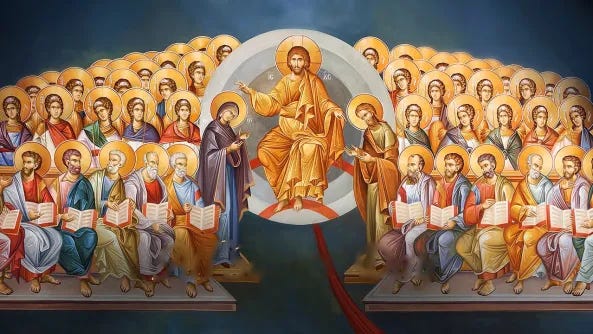
Both Luther and More are on our liturgical calendar in the Anglican Tradition along with the Apostles, the Church Fathers and Mothers, martyrs, bishops, priests, deacons, kings and queens, soldiers, and so many other people. We remember them throughout the year and again on All Saints’ Day. But what about everyone else we’ve known and loved? God knows off us who belong to him and lived their orginary lives in grace and died to join the church triumphant and who, as Saint Peter tells us, have become “partakers of the divine nature”.
All Saints’ reminds us of those who have completed the race. We read the names of all of those who have falled asleep in Christ in the hope of the resurrection from our parish as well as the names you called in and gave to the office of those you have loved and lost.
St. Methodius of Olympia gave us a vision of death I have really connected with and that I draw strength from: “Just as a child in its mother’s womb, which has never seen what is outside, does not understand the world into which it is about to be born, so it is with us. We are like infants enclosed in the womb of this world, unable to comprehend the brilliance and magnitude of the life that awaits us after we break through.” I remember seeing Ellie for the first time, laying on a table in the delivery room under a blue light as she blinked around trying to take in a whole world she couldn’t bring in to focus or understand. There was so much more in this tiny room that she ever could have imagined, much less in the world she would get to know. I imagine that’s what it was like for those who have gone before us.
“The souls of the righteous are in the hand of God,” the Wisdom of Solomon tells us, “and no torment will ever touch them.” Gregory of Nyssa thought it was what St. Paul meant by ‘from glory to glory’: that the saints go on developing into God for ever. They, like us on earth, are continuing to grow in Christ!
For those who have passed, they too are still waiting. We’re all looking “for the resurrection of the dead and the life of the world to come.”
And the soul’s rest is only the middle of the story.
Saint Paul calls Christ, who has been raised from the dead, “the first fruits,” and tonight, everyone we remember is waiting with us for the day when God raises us all, body and soul. That’s why the burial service begins, “I am the resurrection and the life,” and why, at the grave, we say, “in sure and certain hope of the resurrection to eternal life.”
That’s why our hope continues, even in the memorial garden tomorrow morning and why the Prayer Book says that “life is changed, not ended.”
So why pray for the dead at all? Because we love them, and we pray for those that we love. Jesus says God “is not the God of the dead, but of the living: for all live unto him.” If they belong to Christ and we belong to Christ, then we are still conntec through the Church and “surrounded by so great a cloud of witnesses.” I pray for my wife, my daughter, my family, my friends, and those who need Christ that I may not know. I also pray for my dad, grandparents, aunts, uncles, and friends that they find mercy and grace.
Orthodox families praying together on the anniversary of someone’s death, and sometimes on their birthday as well. That’s what we do at my house. When it’s my grandma’s birthday, I pray for. I pray that God grants her life and peace, just as we would have on her birthday when she was alive and that she finds rest in light perpetual. She is still one of God’s own and I still love her.
Within the Anglican tradition, we have a “year’s mind”: a time when we can ask for a Eucharist to be prayed on the anniversary of someone’s death. If there’s someone you’d like remembered on your calendar, let us know the name and we can offer them up with intention during the Eucharist.
Last night kids had a rainy evening knocking on doors throughout the neighborhood. This morning we remembered the glorious saints of God’s flock. Tonight, we pray for those we’ve lost, buried, and still miss, asking God to bless them with rest until they are raised again. Let us mourn, because those who mourn are blessed and will be comforted, but let’s listen to Saint Paul who told us not to grieve as the world does, because we have hope/
Let us pray.
O God, the Creator and Redeemer of all the faithful, grant to the souls of thy servants and handmaids the remission of all their sins, that through our devout prayers they may obtain the pardon they have long desired. Who livest and reignest with the Father and the Holy Ghost, one God, world without end. Amen.
℣ Give them rest eternal, O Lord;
℟And let light perpetual shine upon them.
May they rest in peace, and may all the souls of the faithful departed, through the mercy of God, rest in peace.
Amen.