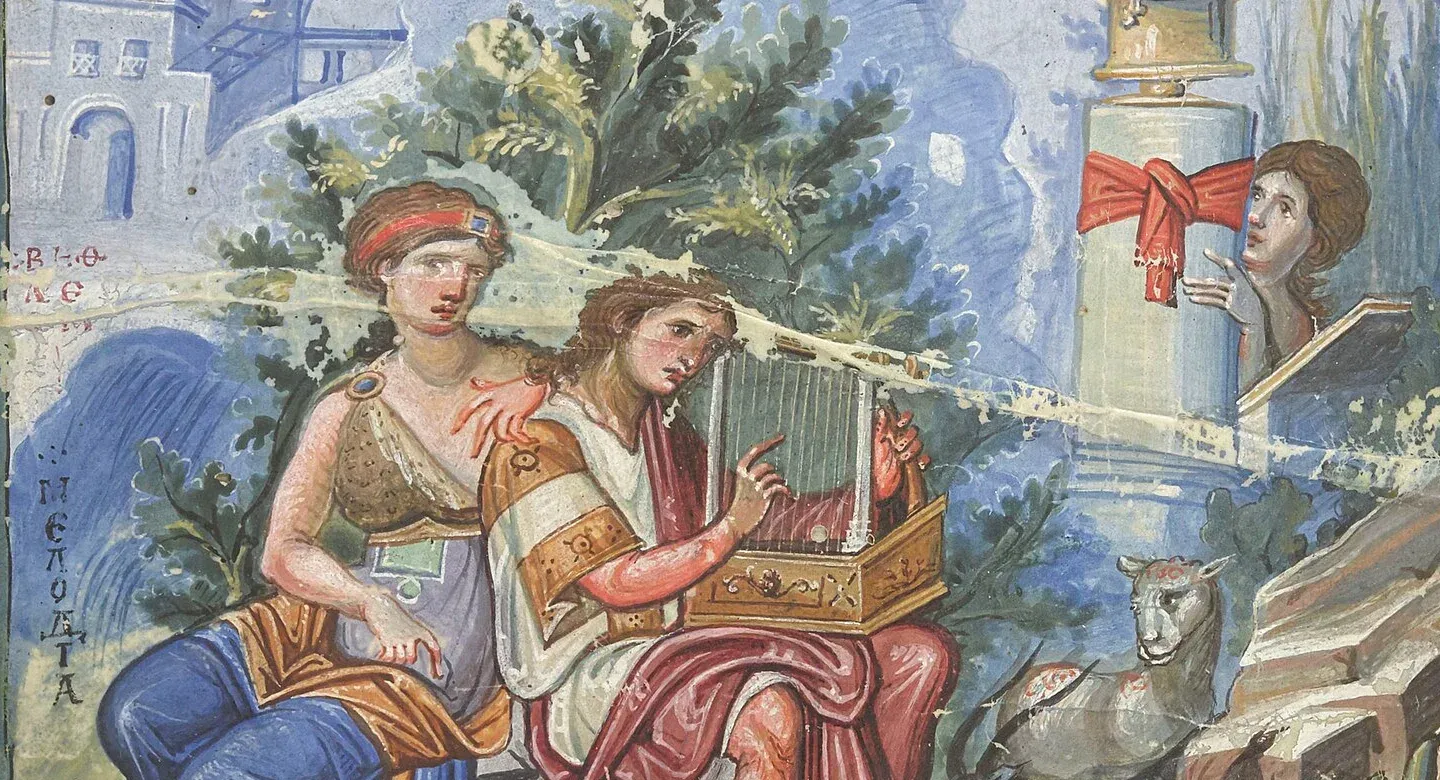
I remember one night when my daughter had just come home from the hospital. She was finally asleep, the house had gone quiet, and the only company I had was our two dogs. I was Orthodox then, and without really deciding to, I started praying the psalm I’d sung at Vespers more times than I could count: Psalm 104 (103 in the Septuagint).
If you’ve spent any time in the Orthodox Church, you know this one. It opens every Vespers. “Bless the Lord, O my soul.” It walks through all of creation, the springs and the mountains, the birds and the wine that gladdens the heart, and then it turns to the end of the day: the sun knows the time of its setting, God makes darkness, and it is night. Standing in that dark house with a newborn asleep down the hall, it was exactly what I needed to say.
I spent twenty years in the Orthodox Church, and that is where I learned to pray the Psalms. Not just to read them, but to have them in my bones. That has shaped my spirituality more than almost anything else, and I’m grateful for it. Even now, years later and as an Anglican priest, I find myself praying Psalm 104 in the evenings, sometimes out loud and sometimes just under my breath.
A psalm for every season of life
That’s the thing about the Psalms. Pray them long enough and they stick, and they show up right when you need them. I have a few that I reach for again and again. When I wake up, it’s Psalm 103 (102 LXX), which Orthodox Christians know from the Six Psalms at Matins. When I’m stressed and overwhelmed, it’s Psalm 143, another of the Six Psalms. When I need to repent, or I’m just in a bad place, it’s Psalm 51 (50 LXX). And when I’m grateful, Psalm 138 (137 LXX) gives me the words. I could keep going, but you get the idea.
St. Athanasius put it better than I can. Writing to his friend Marcellinus about the Psalms, he said:
“And it seems to me that these words become like a mirror to the person singing them, so that he might perceive himself and the emotions of his soul.” St. Athanasius, Letter to Marcellinus, 12
Finding the Psalter again in the Prayer Book
When I made my way into the Anglican tradition, one of the first things that made me feel at home was how seriously Anglicans take the Psalms. The whole Psalter is right there in the Book of Common Prayer, and the Prayer Book tradition is to pray through all 150 Psalms every month at Morning and Evening Prayer. The Psalter is divided into thirty days, with a portion for each morning and each evening, so if you pray the Daily Office you cover the whole book every month. The 1979 Prayer Book also gives a seven-week cycle in its Daily Office lectionary, but the old thirty-day division is still printed right in the Psalter, and plenty of us still use it.
That rhythm goes back a long way. St. Benedict made the Psalms the backbone of the Divine Office, and in his Rule he laid out the Psalter so that his monks would pray all 150 every week. He even admits that the earlier monks did it in a single day:
“For we read that our holy Fathers, energetic as they were, did all this in a single day. Let us hope that we, lukewarm as we are, can achieve it in a whole week.” St. Benedict, Rule, 18
That weekly pattern is still alive today. Benedictine monasteries keep it, and Anglo-Catholics who pray the Anglican Breviary keep it too. The Orthodox Church reads the whole Psalter every week as well, divided into twenty sections called kathismata, and during Great Lent it reads it through twice a week.
Thomas Cranmer knew that most people, monks and laypeople alike, couldn’t keep the full round of monastic hours. So when he put together the Book of Common Prayer, he folded those services into two: Morning Prayer and Evening Prayer. That made the daily office something ordinary Christians could actually keep, and the monthly Psalter came with it. On top of that, the Psalms are woven all through the rest of the Prayer Book, in the canticles, the Eucharist, and the pastoral offices.
The prayer book of Jesus and the Apostles
The Psalter has been the Church’s prayer book from the very beginning, and before that it was Israel’s. In Acts we see the Apostles keeping the hours of prayer (Acts 3:1; 10:9), and Paul and Silas sing hymns to God at midnight in a Philippian jail (Acts 16:25). When the first Christians pray together after Peter and John are released, they pray with the words of Psalm 2 (Acts 4:24–26).
Jesus prayed the Psalms too. He quotes them all through the Gospels (Matthew 21:42; 22:44; John 10:34; 13:18), and they were on His lips at the very end. On the cross He cried out the opening of Psalm 22, “My God, my God, why have you forsaken me?” (Matthew 27:46), and He gave up His spirit with the words of Psalm 31, “Father, into your hands I commit my spirit” (Luke 23:46).
A letter preserved among St. Jerome’s, written from Bethlehem to invite their friend Marcella to come and join them there, describes a whole countryside that sang the Psalms while it worked:
“Wherever you turn, the labourer at the plough sings alleluia, the toiling mower cheers himself with psalms, and the vine-dresser while he prunes his vines sings one of the songs of David.” Paula and Eustochium to Marcella, in St. Jerome, Letter 46, 12
Why it matters
The Psalms give us words when we don’t have any of our own. They connect us to everyone who has prayed them before us, from David to the Apostles to the monks and grandmothers and priests of every age. And they teach us how to pray. Richard Hooker, who did more than anyone to shape how Anglicans think about worship, said it this way:
“What is there necessary for man to know which the Psalms are not able to teach? They are to beginners an easy and familiar introduction, a mighty augmentation of all virtue and knowledge in such as are entered before, a strong confirmation to the most perfect amongst others.” Richard Hooker, Of the Laws of Ecclesiastical Polity, V.37.2
A while back I picked up a scripture journal of the Psalms, and I’ve been working through it slowly, taking notes and praying with each one. I keep finding something new, even in psalms I thought I knew by heart, and they keep drawing me closer to Christ.
How to begin
You don’t need to do all 150 at once. Start with one psalm in the evening. Psalm 104 is a good one, if you’d like to borrow mine. When you’re ready for more, open the Prayer Book to the Psalter and pray the portion for the day of the month, morning and evening. Miss a day? Just pick up where the calendar is. The Church has been praying these words for thousands of years, and the Psalter will still be there tomorrow.